
Why Your 1 on 1 Meetings Fail (And How to Fix Them)
The 1:1 (pronounced one-on-one or one-to-one) is a recurring meeting between a manager and a team member. In this article, I explain why the 1:1 is a management must-have, what it brings to both managers and their direct reports, how often they should occur, and how to maximize their value.
What 1:1s Have to Offer
There are numerous advantages to organizing these meetings, both for the manager and the managed.
For the Manager
The 1:1 is an opportunity to pass on information directly to an employee (such as company updates or new team processes), to check in on project progress (freeing up the Daily Scrum to return to its original function of team synchronization), to request feedback on other staff members (for 360 reviews or probation monitoring), to set or monitor individual objectives, and to deliver feedback.
For the Direct Report
It is an occasion to ask administrative questions, gain visibility on upcoming projects, clarify information from previous meetings, ask for help with roadblocks, resolve interpersonal difficulties, or report technical or human bottlenecks.
How Long Should a 1:1 Last?
I recommend scheduling 30-minute sessions. This duration strikes the perfect balance: enough time to exchange views on meaningful topics, but short enough to remain efficient.
Early in my career, I experimented with one-hour meetings. In practice, they often finished 30 minutes early, or the second half devolved into casual chit-chat. Holding 1:1s longer than 45 minutes is often counterproductive, as attention spans drop. Furthermore, it puts a heavy strain on your schedule. Finding 30 minutes of common free time is relatively easy; finding a recurrent 1-hour slot is much more complicated. You end up postponing or canceling, which damages your professional image—people feel they can’t count on this time with you.
Conversely, attempting 1:1s in less than 30 minutes often leads to overruns. If you have back-to-back meetings, this creates a snowball effect, making you late for everyone else. You might also rush through important messages or omit them entirely to catch up.
I also advise against leaving 15-minute buffers between meetings “just in case.” It forces you to remain concise. To stick to the schedule, I keep an eye on the clock. I let my team member know when it’s time to switch to my topics. If a subject requires more time, we can continue asynchronously or schedule a dedicated follow-up.
Finally, a study by Mark Horstman in his book “The Effective Manager” reached the same conclusion: optimal effectiveness is achieved at 30 minutes. Beyond that, the diminishing returns do not justify the time investment.
How Often Should You Meet?
Every week.
Here is why: the week is the standard unit of time in the business world. It consists of 5 consecutive days followed by a reset. We start with a weekly team meeting, set weekly objectives, and resolve issues within the week.
Following this logic, I organize a weekly 1:1 with my direct reports. It guarantees we have a moment to discuss the week’s events while they are fresh. It allows me to monitor projects and individual objectives from a reasonable distance without needing micromanagement or ad-hoc interruptions.
Common Objections to Weekly Frequency
People often argue for bi-weekly meetings. Here is why I stick to weekly:
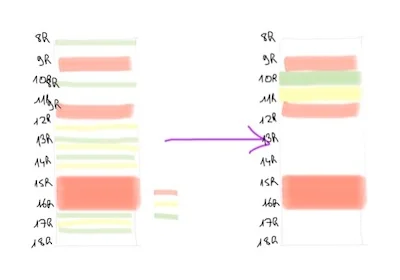
Avoids untimely interruptions, and packs them into 30-minute slots
“30 minutes a week is too much time.” Some managers see this as a waste of time. However, if you work 40 hours a week, 30 minutes represents only 1.25% of your time per employee. This is incredibly reasonable considering that during this 1.25%, you are exercising the majority of your management role: building bonds, setting objectives, delegating, and giving feedback.
“We don’t have enough to talk about.” The first few meetings might feel awkward. This is normal; building a bond takes time. As I explain in the structure section below, a few weeks are usually enough to eliminate this issue. While you wait for the rapport to build, prepare topics in advance (feedback on a ritual, project progress, etc.).
“I am also an Individual Contributor (IC), I don’t have time.” Many Tech Leads or Engineering Managers are also ICs. However, your primary missions are Retention and Results. Your IC output is secondary to these goals. Used wisely, 1:1s are your most effective tool for achieving retention and results.
Pro-tip: I try to schedule my 1:1s between Tuesday and Thursday, preferably in the mornings. Monday is often too early to be effective, and by Friday, most issues are already resolved or stale. Grouping them in the mornings limits context switching, leaving your afternoons free for deep work.
The 1:1 Structure: The 10/10/10 Rule
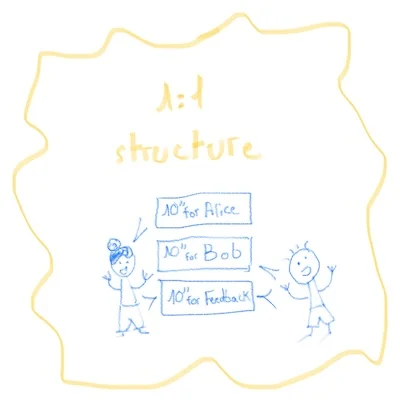
1:1 divided in 3 chunks of 10 minutes
I divide the 30 minutes into three distinct 10-minute chunks:
-
The Direct’s 10 Minutes: The first slot belongs to them. They can talk about whatever is on their mind: current tasks, blockers, communication issues, clarification on a CEO announcement, or even the video game they played over the weekend. This is their time to use as they please.
-
The Manager’s 10 Minutes: This is your time. Use it to get visibility on work, set objectives, practice delegation, or share company news. It’s also your time to build a relationship, so casual topics are welcome here too.
-
The Feedback 10 Minutes: The final slot is for coaching and growth. Use this to give feedback on their work, their role in the team, or their behavior. You might not have 10 minutes of feedback every single week, but keeping this placeholder encourages a culture of continuous improvement.
Over a year, this balance ensures that 1/3 of your time is dedicated to listening, 1/3 to managing, and 1/3 to coaching.
Who Should You Meet?
This works best if your span of control is reasonable. Based on literature (Jeff Bezos’ “Two Pizza Rule”, Scrum guidelines, or Google’s research), a team should ideally be between 5 and 8 people.
In my experience, 8 people is the critical limit. Up to this size, weekly 1:1s are manageable. Beyond that, consider splitting the team or delegating management responsibilities to senior members who can act as intermediaries.
Logistics and Best Practices
Should it be recurring? Yes. Use your calendar’s recurrence feature. It avoids the weekly administrative burden of scheduling and provides a sense of stability for your team. They know they can count on this slot.
Can I cancel a 1:1? No. Unless you are physically not working that week (e.g., vacation). In all other cases, honor the meeting. If you have an unmovable conflict (client meeting, boss summons), move the 1:1 to a different slot in the same week—ideally earlier than the original time. This sends a powerful message: “I have to move our meeting, but you are important to me, so I’m making sure we speak sooner rather than later.”
What if they have nothing to say? Don’t force it. If they have nothing for their 10 minutes, move on to your section. In the beginning, prepare questions to prompt discussion (e.g., asking for feedback on a team meeting).
However, silence can sometimes hide a lack of inspiration rather than a lack of issues. As a manager, keep a few ‘back-pocket questions’ ready to spark meaningful conversations and uncover hidden blockers. Here are my favorites:
- The Roadblock buster: ‘What is the biggest time-waster for you right now?’
- The Team pulse: ‘Who in the team have you enjoyed working with recently? And who are you struggling to align with?’
- The Long-term view: ‘What’s one skill you’d like to master before the end of the year?’
- The Magic Wand: ‘If you could change one thing about our team processes today, what would it be?’
Using just one of these questions can turn a 5-minute awkward silence into a 20-minute deep dive into team dynamics or career growth.
Laptops and Note-taking Traditional advice suggests avoiding screens to show focus. However, in a post-COVID, remote-first world, the laptop is indispensable.
I replace the traditional notebook with a shared online document.
- It ensures both parties have access to history, decisions, and action items.
- It allows you to write down objectives and feedback clearly.
- It enables asynchronous preparation: both of you can add agenda items throughout the week before the meeting starts.
To help you get started, here is the exact template I use in my shared documents (Google Doc or Notion for example). Feel free to copy-paste it:
📅 Date: [Insert Date]
1. 🗣️ Your Topics (The Direct)
- [Topic A]
- [Topic B]
- …
2. 💼 My Topics (The Manager)
- [Project Update]
- [Admin / HR info]
- …
✅ Action Items for next week:
(to be written during the meeting)
- [@Direct] Topic A
- [@Direct] Topic B
- [@Manager] Topic C
- …
A quick note on Feedback: You will notice I didn’t add a section for “Feedback” in this shared agenda. This is intentional. I believe feedback—especially constructive feedback—must be delivered orally during the meeting. Writing it down asynchronously in a shared document beforehand can be a major source of stress for your direct report (“What did I do wrong?”), leading to unnecessary anxiety or misunderstandings before the meeting even starts. Keep the written record for the Action Items or your private notes, but deliver the message face-to-face first.
Having this visible structure forces both parties to prepare. If the document is empty on Monday morning, I know I need to nudge my team member to think about our agenda beforehand.
Crucial rule: Do not be disturbed. Turn off notifications (Slack, Email, SMS). Dedicate this time solely to your team member.
Conclusion
Although every manager has their own style, the 1:1 is the one ritual worth investing in heavily. It covers a vast portion of your managerial duties. I hope this article helps you unlock the full potential of these meetings and implement them effectively with your team.