Don't Waste the Trial Period: A Framework for Hiring Success
Hiring a new engineer is a pivotal part of a manager’s mission. While interviews allow us to evaluate a candidate’s technical mastery (through coding exercises, pair programming, or repository reviews) and soft skills (communication, fluency, conciseness, adaptability), they remain imperfect predictors. Even if you assess cultural fit, complementary skills, and interpersonal chemistry, you cannot be 100% certain you’ve found the right match until the person actually joins the team.
In reality, the hiring process is a filter designed to remove candidates who clearly don’t match the mandatory requirements. However, success depends on variables like the interviewer’s experience, the relevance of the questions, and unavoidable subjectivity. It is only when the person joins that you can validate if your hiring assumptions were correct.
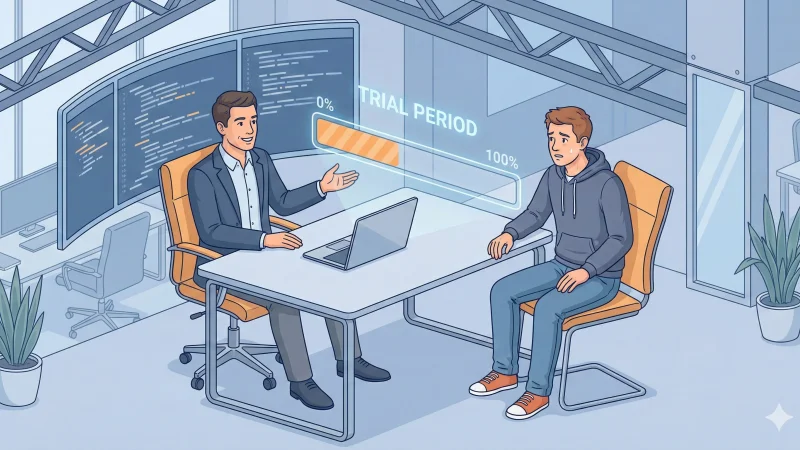
The trial period (or probation period) is a legal mechanism allowing both the company and the engineer to terminate the employment contract within a limited timeframe—typically four months in France. While not mandatory by law, it is almost systematically imposed by companies.
In France, for example, the period can be renewed if one party isn’t fully convinced. The maximum duration for an engineer (executive status) is generally eight months (an initial 4 months, renewable once).
Note. Either party can end the trial period at any time, subject to notice periods (which I will cover in the section “Should I terminate the trial period?”). Therefore, transparency about the role and benefits during the interview process is crucial to avoid early disillusionment.
Some statistics on trial periods (Focus on France)
According to DARES, in 2020, approximately 19% of long-term contracts (CDI) in France were terminated during the trial period. This figure rises to 20% in the service sector.
A 2017 study highlights that while IT companies hire significantly relative to their size (14.9%), they often struggle to target the right profiles (2.1% error rate). The study estimates that a failed hire during the trial period costs between €50k and €100k, representing roughly 4.31% of a company’s total wage bill.
Furthermore, Payjob reports that employees initiate 61% of premature trial period terminations. Of these, 40% are due to “professional disillusionment”—a gap between the promise of the interview and the reality of the job.
To fix this, managers must:
-
Be transparent about the mission and environment.
-
Dig deeper into the candidate’s motivation.
-
Reinforce the verification of essential skills.
Monitoring the trial period
The trial period is undeniably stressful for an employee. Whether they left a comfortable job for your company’s values, sought a new challenge, or are fresh graduates, they are stepping into the unknown. They must learn processes, integrate with a new team, master new tech, and perform—all while a “Sword of Damocles” hangs over their head.
As a manager, you must be empathetic to this mindset. Your goal is to remove unnecessary stress and give them every chance to succeed.
How to support them:
-
Communicate regularly: explicit feedback is key.
-
Clarify expectations: Share a 30/60/90-day plan with specific tasks.
-
Gather 360° feedback: Talk to their peers.
-
Address issues immediately: If signals are negative, clearly define areas for improvement so they can adjust.
Should I renew the trial period?
Short answer: No. Unless you have specific doubts, do not renew.
For an engineer, 4 months is usually enough to assess fit. Automatically renewing the period without a solid reason is unfair. It signals that you don’t value their efforts and unnecessarily prolongs their insecurity.
Valid reasons to renew:
-
Lack of conviction: You haven’t seen enough to be sure (though this is often a red flag for your own management process).
-
Emerging blockers: A specific issue arose that needs time to be corrected.
-
Team doubts: The team is hesitant about the collaboration.
Warning. If you renew because you are undecided, you must immediately define specific criteria to validate during the extension. Otherwise, you risk reaching the end of the second period still hesitating, potentially leading to a regrettable hiring decision.
Should I validate the trial period?
If you are satisfied, congratulations! To confirm your decision, ask yourself these questions:
Hard Skills
-
Is the code quality and seniority aligned with the role?
-
Did they ramp up quickly?
-
Is the technical feedback from peers positive?
Soft Skills & Team Fit
-
Are they well-integrated?
-
Have they demonstrated the complementary skills you hired them for?
-
Have they adopted team practices (e.g., TDD, Pair Programming)?
Company Culture
-
Are they professional (punctuality, participation)?
-
Do they embody company values (e.g., “Disagree and Commit”)?
Should I terminate the trial period?
Tip: Do not wait for a scheduled monthly meeting if a critical issue arises. Address it immediately.
Keeping an employee when you know it’s not working is always the wrong decision. It is unfair to the employee and harmful to the team.
A Personal Failure:
“I once hired an engineer who was a perfect technical match but raised red flags on soft skills during the interview. I ignored my gut because we were desperate for senior devs. That was my first mistake.
Upon joining, he rejected code review feedback aggressively, calling it ‘ridiculous.’ I confronted him, but ultimately—partly out of fear of restarting the hiring process—I let it slide. The toxicity spread, affecting the team’s mood. I waited until the very end of his trial period to act. Ironically, he quit before I could fire him, citing a lack of interest.
The result? A team that suffered for months and a huge waste of energy. Lesson learned: If mandatory skills (especially behavioral ones) are missing, end it early. Do not compromise.”
If an employee fails to adjust after feedback, it is time to terminate.
Legal Note (France): A notice period applies (24h to 1 month depending on tenure). In cases of toxicity, you can terminate immediately but must pay the salary corresponding to the notice period.
How I organize trial periods
Beyond the standard company onboarding, I set up a specific rhythm:
-
Schedule Checkpoints: Meetings at 2 weeks, 1 month, 2 months, and 3 months.
-
The Follow-up Doc: A shared document tracking goals, feedback, and observations. This is my “partner” in decision-making.
-
Reminders: I set calendar alerts one week before each meeting to gather team feedback, and two weeks before the probation end date to make the final decision.
-
The Kick-off: Before day 1, I explain this process to the new hire so they know exactly how they will be evaluated.
Finally, when validated: Celebrate! 🍾 Announce it to the team. It marks the end of their stress and the beginning of their permanent journey.